Tag: sand

  • Rainfall – May 2025 Update

    Rainfall is a key element of Scottish weather and it dictates how and when the golf course maintenance can be carried out here at Royal Aberdeen Golf Club.


    This year has been an incredibly difficult year with a prolonged winter and cooler temperatures lasting until April, meaning growth was slow at the start of the season. The  freezing temperatures were followed by a prolonged dry spell which meant our irrigation system was being used on a daily basis throughout early Spring. 

     Aberdeen has an average annual rainfall of around 866 mm whereas some areas in Scotland receive about 3,000 mm of precipitation per year.

    As you can see from the stats below it has been a considerably dry year on the links,  we are currently around 130mm below the average precipitation rates for Aberdeen and in comparison to last years data we have had around 263mm less to date.

    The monthly data is slightly misleading whereas the daily chart shows a much different story with long spells where we ran into weeks without any precipitation at all.

    The monthly rainfall totals for 2025 are as follows;

    January 55.6mm
    February 26.2mm
    March 35.2mm
    April 9.4mm
    May 2mm (as of 15/05/2025)

    Total precipitation to date = 126mm

  • Indigenous Dune Sand – Analysis

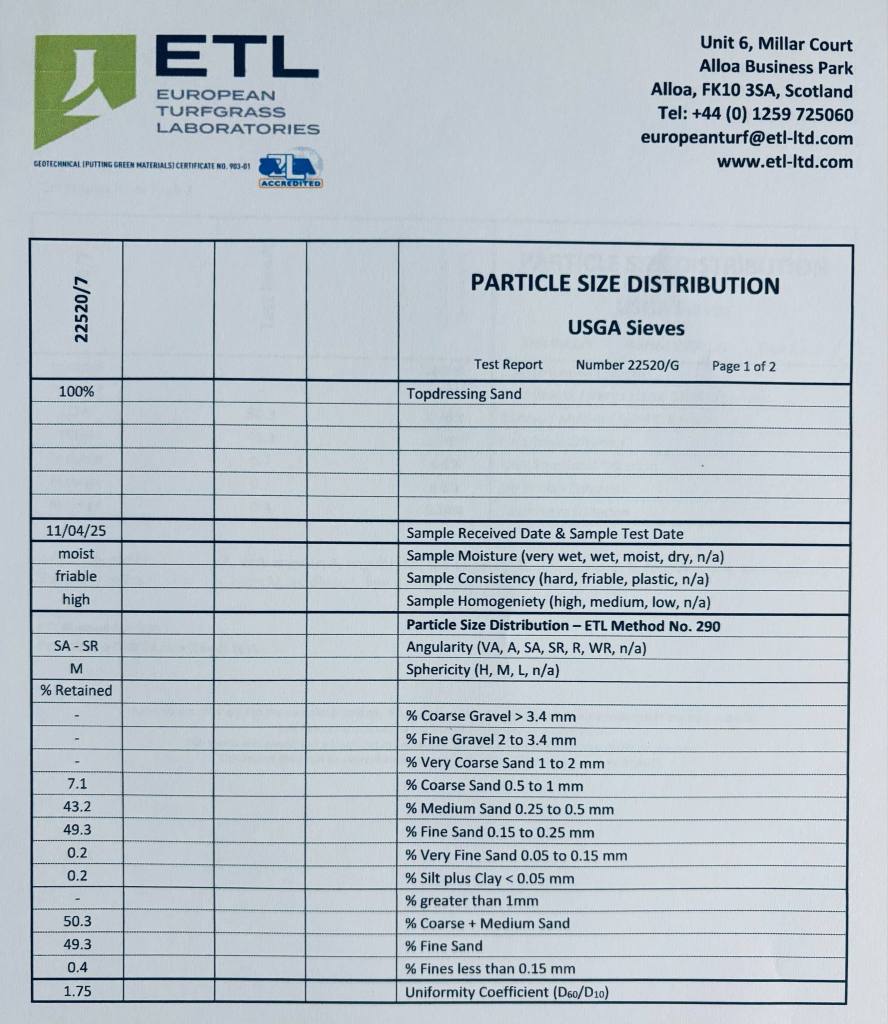
    In order to establish to particle size distribution of our indigenous dune sand topdressing, we had a sample tested to establish the uniformity and amount of coarse sand, medium sand, fine sand, very fine sand and silts within the sample send from our new borrow pit site to the right of hole 7 on Balgownie Links.

    The benefits of sand topdressing are:

    Improved Smoothness – Voids exist within the turf canopy between turfgrass leaves and stems, causing inconsistent ball roll. Sand topdressing helps fill these voids to provide smoother and truer putts.

    Thatch Dilution – The layer of organic debris, stems, crowns and roots in the upper rootzone – i.e., thatch – can become concentrated and encourage mower scalping and localized dry spots. Thatch should be diluted with sand through practices like verticutting and sand topdressing to maintain good turf quality.

    Increased Firmness – Turf produces organic matter in the upper rootzone that creates soft, spongy playing conditions. Regular sand topdressing, along with core aeration, improves surface firmness and resiliency.

    Improved Rootzone – Sand drains well and resists soil compaction. The accumulation of sand from multiple topdressings over many years can improve soil physical properties.

  • Balgownie- Fairway Bunkers Reconstruction – 12th Hole

    As part of our ongoing winter maintenance projects we took the decision to reconstruct the two right hand fairway bunkers on hole twelve. The previous bunkers revetted faces had began to deteriorate, so it was essential that we reconstructed the bunker as part of our winter projects 2024/25 .

    The old bunker faces were removed and the new revetted face was built with turf from our turf nursery and the surrounding area has been turfed with fescue to match the surrounding area. Fresh sand has been added before the bunker was taken back into play for the start of the 2025 golf season.

  • Bunker Etiquette / Advice

    #1 – Locate the lowest spot around the edge of the bunker that is convenient to your ball try not to walk down a steep face possibly damaging the turf edge, and leaving deeper footprints.

    #2 – Carry the rake into the bunker if needed. Contrary to what some golfers believe, it is within the rules and can speed up play, be sure you do not allow the rake to touch or test the sand except when you drop it.

    #3 – Before playing the shot the rake should be dropped behind the area where you take your stance and not used to align the shot.

    #4 – Begin raking over the signs of play, to restore the surface without displacing too much sand by pushing the rake away from you a few times to spread the excess sand forward towards the face.

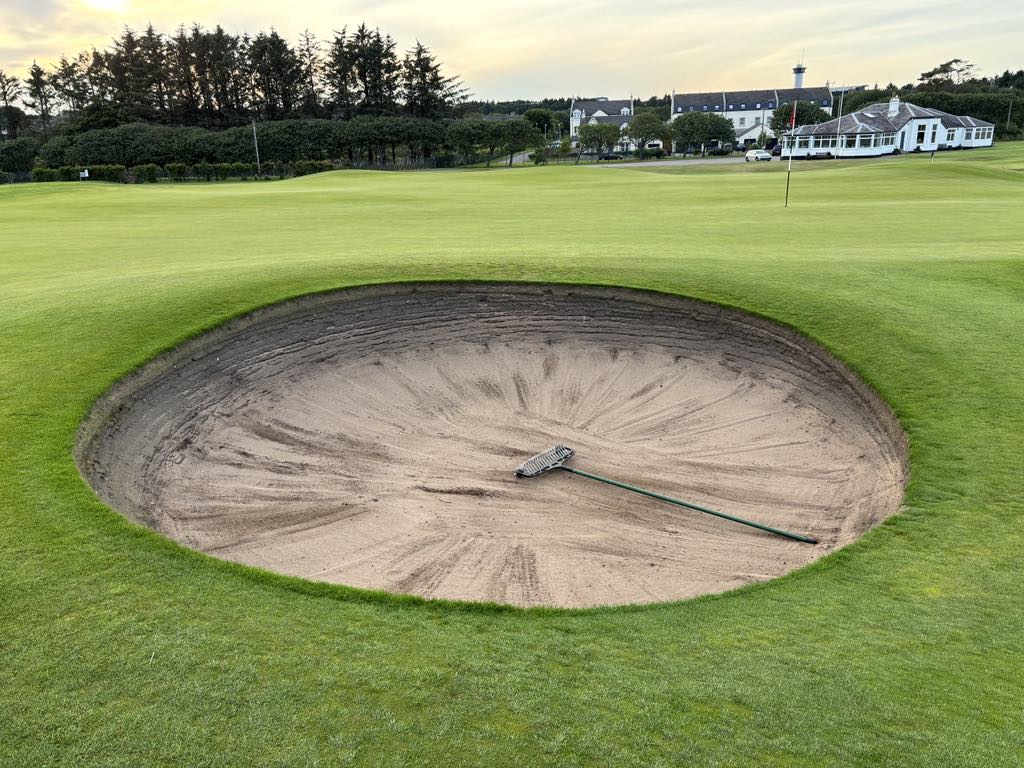
    #5 – Step out of the bunker and make a final few passes. The Rake Should Be Placed Inside the middle of the Bunker. This is normally a balls natural finishing position (especially in our small links pot bunkers) and if your ball hits it , you’re already in the bunker. We feel there is more likelihood of a ball being deflected into, or kept out of, a bunker if the rake is placed outside the bunker.

    If the sand was to be all raked back towards the entry point and rakes left around the edges it almost makes it impossible for the next person who lands in the bunker to escape.