Month: May 2025

  • Rainfall – May 2025 Update

    Rainfall is a key element of Scottish weather and it dictates how and when the golf course maintenance can be carried out here at Royal Aberdeen Golf Club.


    This year has been an incredibly difficult year with a prolonged winter and cooler temperatures lasting until April, meaning growth was slow at the start of the season. The  freezing temperatures were followed by a prolonged dry spell which meant our irrigation system was being used on a daily basis throughout early Spring. 

     Aberdeen has an average annual rainfall of around 866 mm whereas some areas in Scotland receive about 3,000 mm of precipitation per year.

    As you can see from the stats below it has been a considerably dry year on the links,  we are currently around 130mm below the average precipitation rates for Aberdeen and in comparison to last years data we have had around 263mm less to date.

    The monthly data is slightly misleading whereas the daily chart shows a much different story with long spells where we ran into weeks without any precipitation at all.

    The monthly rainfall totals for 2025 are as follows;

    January 55.6mm
    February 26.2mm
    March 35.2mm
    April 9.4mm
    May 2mm (as of 15/05/2025)

    Total precipitation to date = 126mm

  • Balgownie – Soil Ph

    The pH level of the soil is of great importance as it affects the availability of the nutrients to the grass plant. A pH of around 6.0 is thought to give the turf good access to nutrients whilst helping to control any worm problems. Monitoring and adjusting soil pH is a routine practice in golf course maintenance to optimise turf performance.

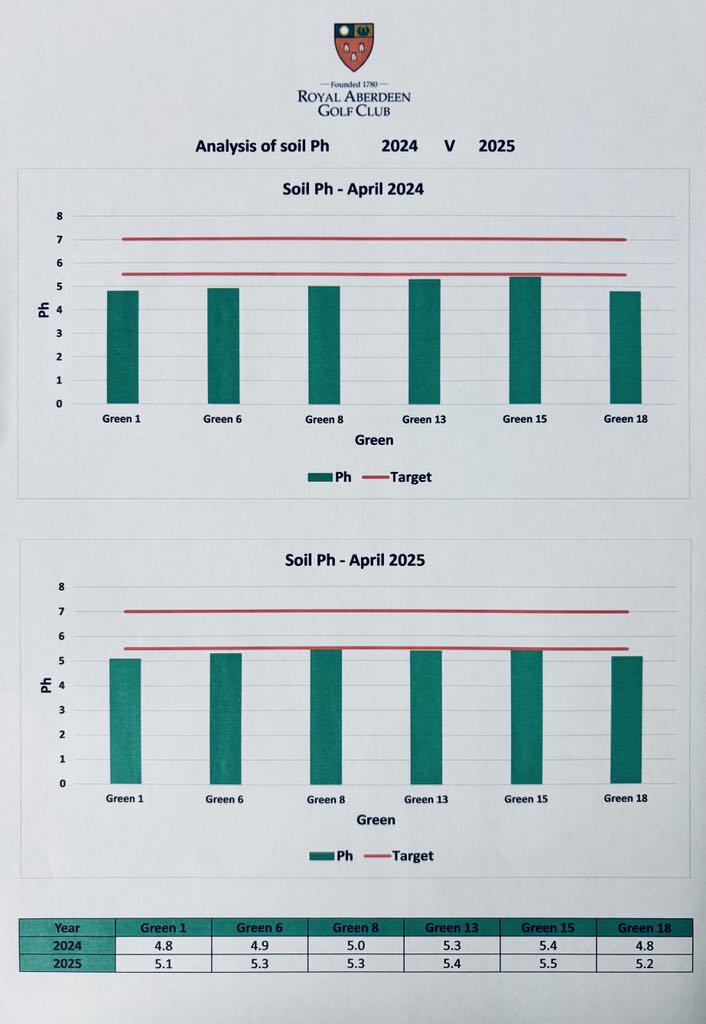
    When tested in early 2024 we found that the pH of the 6 indicator greens tested across the site were low – some as low as 4.8. It was our intention to raise the pH gradually and set ourselves an initial target of 5.5.

    • The maximum amount of essential nutrients are generally available between pH 6.0 – 7.0
    • Most nutrients become ‘locked-up’, or less available, for plant growth at low (acidic) pH levels
    • The majority of soil micro-organisms prefer a soil pH of 6.0 – 8.0
    • Neutral and alkaline soils usually have higher contents of calcium within the soil and this helps towards soil particles aggregating together (i.e., flocculation), improving soil structure.

    Acidic soils

    These can have a detrimental effect on turfgrass growth:

    • Slow or weak growth
    • Inability to stand up to much wear
    • A thin sward coverage
    • Poor quality playing conditions
    • Susceptibility to drought
    • An increased build-up of thatch due to low decomposition rates (which is in turn due to reduced micro-organism activity).
    • A poor response to fertiliser application

    The charts below show a comparison of pH levels 2024 V 2025 and the progress being made to date.

  • Balgownie – Sunrise

    Early mornings at Royal Aberdeen

    Sunrise at Balgownie is not just about the beautiful sights, but also the wonder of nature all around us